OWLS & OTHERS FROM THE NORTH SHORE OF MASSACHUSETTS AND ELSEWHERE ACROSS THE USA

I'm an avid birder and nature photographer wishing to share some of my sightings & images taken while out in the "wilds" of Cape Ann and surrounding New England countryside. More images can be found on my web site at New England Birds Plus Enjoy, Phil Brown


"Click" on any image below for a larger version....


Comments & Question - nebirdsplus@gmail.com

New England Birds Plus Images on SmugMug

Thursday, May 5, 2011

Hummers are BACK! and a Gray / Red Squirrel - May 05, 2011

An early female Ruby-throated Hummingbird at the feeder - April 30, 2011


One of several Baltimore Orioles just back for the breeding season


A red-tailed Gray Squirrel that's been visiting the yard. A 1st for me!


2011 State Of The Birds Report - Dept of the Interior

The full report is available at www.stateofthebirds.org.

U.S. Department of the Interior

AMERICA’S GREAT OUTDOORS: Secretary Salazar Releases 2011 State of the Birds Report

Report Shows Public Lands and Waters Crucial to Birds; One Out of Four Birds Species on Public Land in Peril

05/03/2011


Contact: Hugh Vickery, DOI (202) 208-6414
Alicia F. King, FWS (571) 214-3117

WASHINGTON -- Secretary of the Interior Ken Salazar and Agriculture Under Secretary for Natural Resources and Environment Harris Sherman today released the 2011 State of the Birds Report, the nation’s first assessment of birds on lands and waters owned by the American people. The findings indicate tremendous potential for bird conservation: these publicly owned habitats support at least half of the entire U.S. distributions of more than 300 bird species.
The report concludes that America’s public lands and waters, ranging from national wildlife refuges to national parks to national forests, offer significant opportunities to halt or reverse the decline of many species. More than 1,000 bird species inhabit the U.S., 251 of which are federally threatened, endangered, or of conservation concern. The report provides a scientific tool to help public agencies identify the most significant conservation opportunities in each habitat.
“The State of the Birds report is a measurable indicator of how well we are fulfilling our shared role as stewards of our nation’s public lands and waters,” Salazar said. “Although we have made enormous progress in conserving habitat on public lands, we clearly have much more work to do. The good news is that because birds so extensively use public lands and waters as habitat, effective management and conservation efforts can make a significant difference in whether these species recover or slide towards extinction.”
“The 2011 State of the Birds report reflects significant achievement by public agencies and all of our long-standing partners in improving bird habitats,” said Agriculture Under Secretary for Natural Resources and Environment Harris Sherman. “The USDA programs are innovative and creative. Over the last two years, the Natural Resources Conservation Service has played a critical role in working cooperatively with landowners to conserve migratory birds in the Gulf of Mexico, sage grouse in the great plains, and others. The Forest Service has developed a draft Forest Planning rule that will ensure our National Forests support birds and other wildlife for decades to come.”
The report assessed the distribution of birds on nearly 850 million acres of public land and 3.5 million square miles of ocean. It relied on high-performance computing techniques to generate detailed bird distribution maps based on citizen-science data reported to eBird and information from the U.S. Geological Survey’s Protected Areas Database of the United States.
The report highlighted the wide variety of bird habitats on public lands. These include:
  • Aridlands: More than half of U.S. aridlands are publicly owned. Thirty-nine percent of aridland bird species are of conservation concern and more than 75 percent of species are declining.
  • Oceans and Coasts: All U.S. marine waters are publicly owned and are home to 86 ocean bird species and 173 coastal species. At least 39 percent of U.S. bird species restricted to ocean habitats are declining and almost half are of conservation concern, indicating severe stress in these ecosystems.
  • Forests: Public lands include some of the largest unfragmented blocks of forest, which are crucial for the long-term health of many bird species, including the endangered Kirtland’s warbler, which has 97 percent of its U.S. distribution on public lands.
  • Arctic and Alpine: Ninety percent of boreal forest, alpine, and arctic breeding bird species in Alaska rely on public lands for habitat, including 34 breeding shorebird species of high conservation concern. There are more public lands in Alaska than in the rest of the U.S. combined, offering huge potential to manage lands for conservation.
  • Islands: More birds are in danger of extinction in Hawaii than anywhere else in the U.S. Public lands in Hawaii support 73 percent of the distribution of declining forest birds. Among declining Hawaiian forest birds on Kauai, about 78 percent rely on state land. Four endangered species in the Northwest Hawaiian Islands are entirely dependent on federal lands.
  • Wetlands: Wetlands protection has provided the “gold standard” for bird conservation. On the whole, 39 species of hunted waterfowl have increased by more than 100 percent during the past 40 years as nearly 30 million acres of wetlands have been acquired and management practices have restored bird populations.
  • Grasslands: Grassland birds are among our nation’s fastest declining species, yet only a small amount – 13 percent -- of grassland is publicly owned and managed primarily for conservation. Forty-eight percent of grassland-breeding bird species are of conservation concern, including four with endangered populations.
The 2011 State of the Birds report is a collaborative effort as part of the U.S. North American Bird Conservation Initiative, involving federal and state wildlife agencies, and scientific and conservation organizations. These include the American Bird Conservancy, the Association of Fish and Wildlife Agencies, the Bureau of Land Management, the Cornell Lab of Ornithology, the Department of Defense, the National Audubon Society, The Nature Conservancy, the National Park Service, the U.S.D.A. Forest Service, the U.S. Fish and Wildlife Service, and the U.S. Geological Survey.
The full report is available at www.stateofthebirds.org.

Birders needed to assist with Citizen Science Project in Boston and the North Shore,­ June 2011

The University of Massachusetts, Amherst and the Urban Ecology Institute are looking for 4-6 birders to conduct point counts in Boston, and 6-8 birders to conduct point counts in the North Shore. General locations in Boston include residential streets in Roxbury, Dorchester, East Boston and South Boston, and three urban parks: Franklin Park, Stoneybrook reservation, and the Arnold Arboretum. General locations in the North Shore include residential streets and conservation areas in Danvers, Ipswich, Burlington, and Woburn.

Our study is investigating regional bird diversity and how it varies at different levels of urbanization. Birding sites are located in residential parts of the city and towns, and in large urban parks and conservation areas. The point counts will be conducted during the month of June, 2011. Time commitment includes 2- 4 mornings, depending on interest.  (1-2 mornings in early June and 1-2 mornings in late June) and the schedule is relatively flexible.

Please contact Rachel Danford (rachelsdanford@gmail.com) if you are interested in volunteering for this exciting project. Please indicate which locations you prefer (Boston or North Shore or both), and level of commitment.

Background
We conducted a pilot study in June 2010, focusing exclusively within Boston neighborhoods and three large urban parks. We documented a total of 37 species (20 species in the neighborhood sites and 26 species in the park sites). Highlights included an Eastern Kingbird nest building in a very urban residential site. For the urban parks, highlights included a number of Wood Thrushes, a Pine Warbler, Indigo Buntings, and Scarlet Tanagers.

If interested please contact Rachel Danford with your preferred location (Boston, North Shore, or both) and level of commitment.

Monday, April 25, 2011

Waterthrush & Fox Kits - Salisbury, MA - April 25, 2011

A stop at Crooked Pond in Boxford found the recently arriving Louisiana Waterthrush in full song just past the 1st stream crossing. Though I didn't manage any photos of the bird on this dreary day I did record it's song with the stream and an occasional Pine Warbler signing in the background. What I like about the recording is the lack of car noise, something that is hard to get away from in Massachusetts.

1 minute Louisiana Waterthrush recording

(use your browsers "back button" to return to this page)

Ron Grant of Salisbury pointed me in the direction of a Fox den this morning and much to my delight the kits were out playing in the light rain that fell most of the day. One of the few shots I managed of the foursome that was at this den.


A brief video of the kits playing in the dune grass.


Another pair was seen a bit further west. Wish there had been a bit of sunshine!


THANKS RON!

White-faced Ibis - April 24, 2011

The White-faced Ibis reported from Plum Island just west of lot #3 was present on Sunday morning and paused for a moment for the image below.


Of all the improbable things to happen.... A Peregrine Falcon killed and ate the White-faced Ibis on Tuesday April 26, 2011 and even more incredible... Michael Blust, Professor of Biology at Green Mountain College in Poultney, VT had his class on Parker River NWR, not only watching the entire event but video taping it as  well. The take down of the Ibis by the Peregrine can be seen on You Tube at:


A stop in the Industrial Park in Newburyport on Easter Sunday found a male American Kestrel making a meal out of a meadow vole. He disappeared shortly after catching it, I'm guessing he took it to the female as she sits on their nest.


A Green Heron was back on territory in a small pond just north of the Parker River along Rte 1 in Newbury. All in all a very pleasant day of birding with temps in the 60's and the reported showers not materializing.

Saturday, April 23, 2011

Rainy Day Yard Birds - April 23, 2011

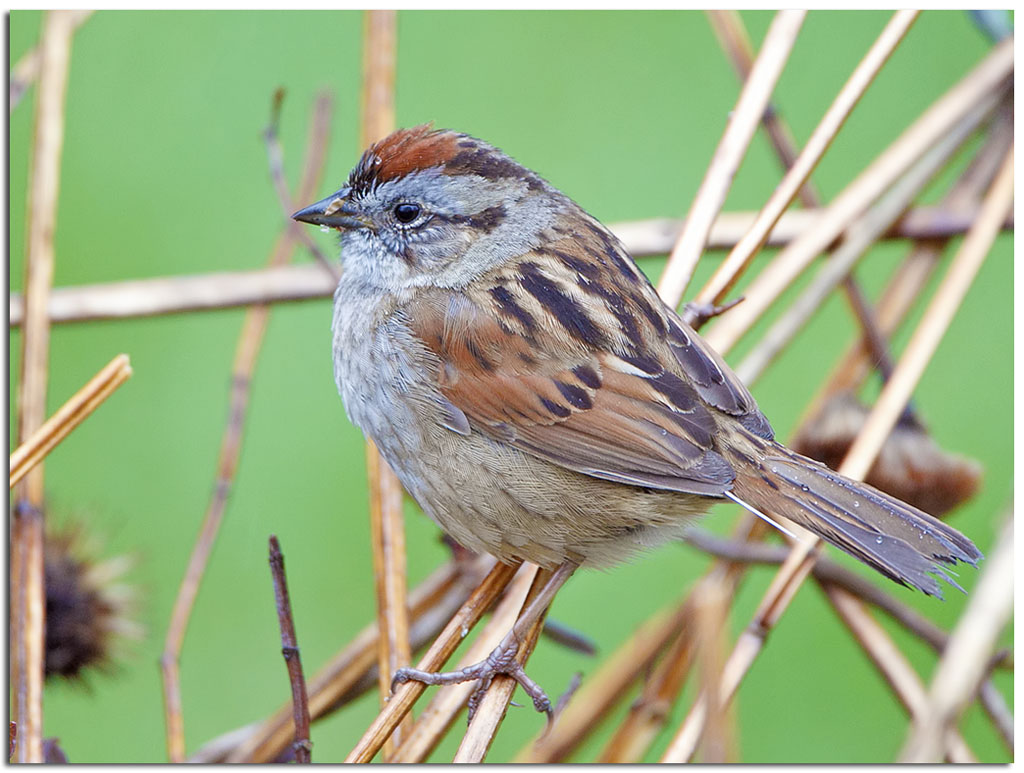
A check of the feeders after work this afternoon found a Swamp Sparrow watching the many Blackbirds that visit for several weeks each spring. The newly emerged grass made for a colorful out of focus background.


A bit of video of the Swamp Sparrow as it watched all of the feeder birds.

Another brown capped Sparrow that visits through the summer while nesting in the yard arrived a few weeks ago. Chipping Sparrows are a regular visitor for 3/4 of the year.


A bit of selective black and white applied to the next image gave this American Goldfinch a bit of pop on this otherwise gloomy day.

Cox Reservation - Island Road, Essex - April 22, 2011

A few stops along Island Road in Essex this week turned up several American Kestrel, stopping for some food and a brief rest before heading off to continue migrating to their breeding grounds. A half dozen Glossy Ibis were a treat to see as well.


A bit of time spent on the evening of the 22nd at the Cox Reservation along Eastern Ave. in Essex did not find me spending any quality time with the pair of Osprey that appear to have taken up residence on the nest platform placed along the marsh. They can be seen below in this very distant image (1/2 mile or more) as they had a bite to eat atop the poles in the top right.


Though they did eventually flyby the platform they appeared to be heading inland a bit to roost for the evening. Some of the other birds that passed by while I watched included 20 Great Egret heading to roost just off the coast at Kettle Island in Magnolia.


and a pair of Eastern Bluebirds that have taken over one of the many nest boxes for this years season. The female stopped long enough  for the image below.


Earlier in the week I was given a tour of the Merrimac Woods by Merrimac's very own Bonnie Buxton with the Broad-winged Hawk, seen below, being one of several highlights. Thanks Bonnie!

Sunday, April 17, 2011

Yellow-legged Gull (probable) April 17, 2011

A stop at Kalmus Beach in Hyannis this morning found the probable Yellow-legged Gull in the parking lot for several minutes. It gave it's long call once which can be seen and heard (with quite a bit of noise from the 20 - 25mph winds) in the 8 second video below. A larger version can be seen on Vimeo at: http://vimeo.com/22531129


A few photos of the gull


Thursday, April 14, 2011

Recent Arrivals - April 2011

A stop in Winthrop this past weekend found 4 American Oystercatchers noisily flying around Snake Island. This adult was just coming on for a landing.


Island Road in Essex is a great spot to find an early Snowy Egret or two. This one is showing it's breeding plumage off to several others nearby.


The office has quite a few spring flowers that come up early each year from the heat the raised foundation holds. The Daffodils are a favorite of mine.

Tuesday, April 5, 2011

Burrowing Owl and Crested Caracara Video - March 2011

A visit to Cape Coral, FL in March of 2011 afforded a visit with several Burrowing Owls at their burrows situated on vacant lots around town.


Burrowing Owl - Cape Coral, FL - March 2011 from Phil Brown on Vimeo.

A 2 minute video of a Crested Caracara as it feeds on a road killed Armadillo along Rte 80 outside of Fort Myers, FL in late March 2011


Sunday, April 3, 2011

Great Horned Owls - April 03, 2011

I visited a Great Horned Owl nest in Hamilton this afternoon, one adult & 2 youngster, and was amused by their indifference to the very windy conditions. That's quite a ride as you can see in the brief video below.


and a still shot of the threesome as they sit approximately 40' up in a White Pine

Ding Darling NWR - last few hours of vacation - April 02, 2011

An early morning stop at Ding Darling prior to my flight home found the tide and birds in sync for the 1st time since my arrival 10 days ago. Spoonbills in flight, loads of awesome reflections and way too many birds in motion at once, nice problem to have!

American White Pelicans & Roseate Spoonbills

Roseate Spoonbill

Roseate Spoonbill

Roseate Spoonbill

Roseate Spoonbill

Tri-colored Heron

Tri-colored Heron

White Ibis

Roseate Spoonbill

White Ibis - Roseate Spoonbill

 Tri-colored Heron

White Ibis


A few shots of what the waders were dining on.

Great Egret

Roseate Spoonbill

Roseate Spoonbill

Reddish Egret

White Ibis

and a few more Burrowing Owl images from the night before.


What a fabulous end to a very enjoyable vacation.